I was almost 20 when I first saw Guillermo del Toro’s debut film, Cronos. I don’t even remember how I got my hands on it back then, but the experience was nothing short of a cinematic shock. It’s true that I grew up on the madness of Romero and Carpenter, though I consumed their films mainly as entertainment but encountering this young filmmaker (at the time) who crafted so much of his raw sci-fi world by himself felt like a revelation. And he was Mexican! He could have followed the clichés, made a film about Mexican wrestlers or an El Mariachi-style story… but instead he created a genre-bending sci-fi film at such a young age. Of course, that thought is partly ironic a little black-humor joke, the kind he himself would appreciate. But Cronos was my first real encounter with del Toro’s universe.
From the beginning, he built a whole new world dark, tender, infused with love and death, using both traditional cinematic language and futuristic imagination, without falling into the trap of becoming another cog in a franchise machine (hellboy is something else entirely). Unlike the logic of George Lucas or the American superheroes who must suffer to earn our sympathy before saving the world, del Toro has always chosen a more intimate path. His films breathe humanism, poetry, openness… a love for “the others” and the otherness within ourselves.
The Marrakech Master Class:
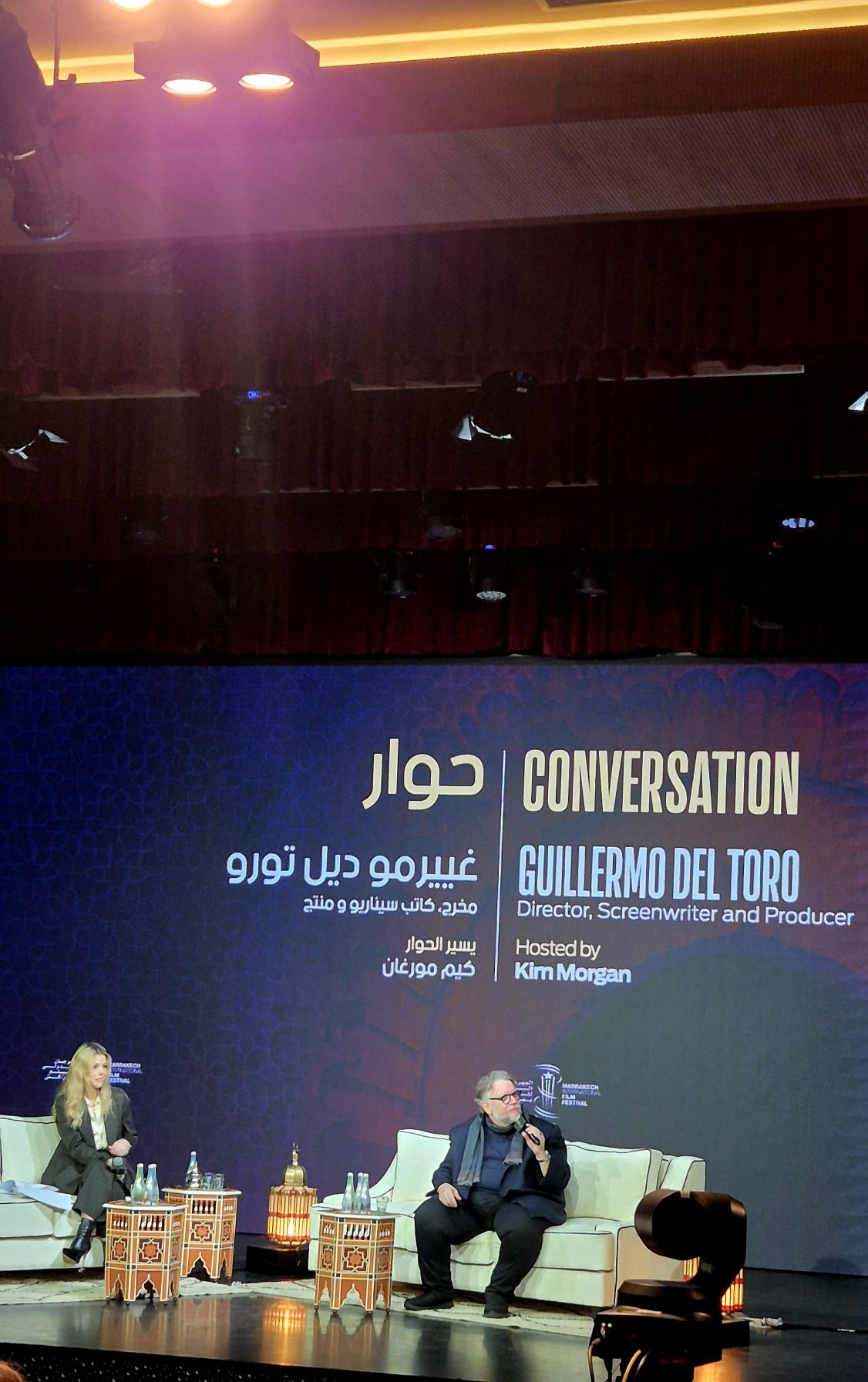
Today I want to reflect on his master class at the Marrakech International Film Festival, a conversation led by his wife, Kim Morgan. Unlike some festival dialogues where the questions feel flat or recycled, this one was completely different. It felt like a genuine exchange between cinephiles. Ideas floated in the room like poetry, beautiful, almost spiritual.
Del Toro and Morgan had prepared their own film excerpts to share with the audience, and the respect they showed the public was palpable. The audience returned that love, and the result was perhaps the longest Q&A session between a filmmaker and the public in the history of the festival. Del Toro wanted to stay longer and continue the conversation, but the festival director eventually had to step in to close the session which is understandable.
Death, Emotion, and the World Today:
Del Toro spoke openly about death, saying he even looks forward to it because in death, there is no future left to worry about. He confessed that he has no social life outside of cinema. His reflections on contemporary emotional suppression revealed deep cultural concerns:
“I’m Mexican, so emotion is big for me. I think emotion is very scarce right now. We have come to a point in civilization when emotion seems to be something you hide.”
He continued with one of the most striking thoughts of the evening:
“We are in a horrible moment where cynicism simulates intelligence. If you say, ‘I believe in love,’ you’re a fool. If you say, ‘I don’t believe in love,’ you’re a wise man. I don’t agree with any of that.”